Circuit training has been traditionally been used as an effective way to develop both strength and cardiovascular fitness simultaneously. Circuit classes are popular in gyms and with non-athletes because of the variety they offer over continuous exercise such as running and cycling.
However, circuit training is not a form of exercise per se, but relates to how an exercise session is structured (3). A circuit session consists of a series of exercises or stations performed in succession with minimal rest intervals in between.
This article outlines how to design an effective circuit training program for either general fitness or to improve sport-specific performance. You will also find sample programs, routines and workouts for different performance outcomes.

How Circuit Training Can Be Used
- For General Fitness
Completing a variety of resistance exercises and high intensity cardiovascular exercises in quick succession can improve both strength and endurance (3). For individuals short on time, 3-4 brief sessions per week is an effective way to develop all-round fitness. - For Basic Strength Development
Athletes embarking on a sport specific strength training program should always start with a phase of basic strength training (1). This generally occurs during the closed season in the early part of the preparation phase and is used to prepare the body for more strenuous work later on.Even experienced athletes require a phase of basic strength training to help correct some of the muscle imbalances that inevitably occur with competitive sport. Circuit training is a good choice as alternating exercises allows for maximum recovery of muscle groups. Increased rest intervals between stations is important as this phase of training should not be too intense.
- For Strength Endurance Development
Many athletes require good muscular endurance for effective performance in their sport. A circuit training session can be developed to meet their specific needs. By keeping rest intervals short a cardiovascular element is developed and by alternating exercises ad muscle groups, more work can be completed for a longer period. Circuit training for a multi-sprint sport such as soccer will differ significantly compared to circuit training for a marathon runner for example.
Circuit Training Guidelines For General Fitness
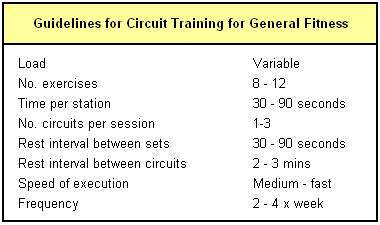
Circuit training can be completed 2-4 times per week. As with resistance training at least 48 hours should be left between sessions that work the same muscle groups.
For general fitness a resistance should be chosen that allows the station to be completed for the prescribed period of time (1-2 minutes for example). Resistance may also be governed by bodyweight and the weight of the implements used, such as medicine balls.
Circuit training classes consist of about 8-12 stations. These are usually completed for 30-90 seconds with 30-90 seconds rest between each station. Progression can come through either increasing the station time or decreasing the rest intervals. Choose only one at a time however. A total of 1-3 circuits is typical with 2-3 minutes rest between each circuit (2).
This type of circuit can also be used by athletes during closed or off season training. Two or three circuit resistance training sessions can be interspersed with 2-3 cross-training cardiovascular workouts.
Circuit Training Guidelines For Short-Term Strength Endurance
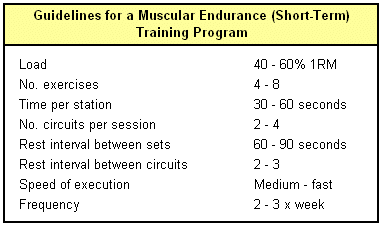
Sports such as soccer and field hockey benefit consist of repetitive bouts of high intensity work. Circuit training, with stations lasting 30-60 seconds, is an ideal way to develop specific strength endurance for these events. The number of exercises in a circuit should be lower than that found in most general fitness circuits and exercise selection should ideally mirror those movements found in competition.
Click here for sample circuit training programs for multi-sprint events.
Circuit Training Guidelines For Long-Term Strength Endurance
Continuous endurance events such as distance cycling, running and rowing require a different program design. While exercises are still completed in sequence, the length of each station and rest periods bear little resemblance to that of classical circuit training. Very light loads are used so that each exercise can be completed for prolonged period of time. Progression gradually reduces the rest periods between stations to zero, so that in effect each station is completed back-to-back.
Its important to note that while circuit training can improve VO2max, particularly in untrained individuals, it is not as effective as aerobic endurance training for improving aerobic power (4). It goes without saying that circuit training is complimentary to endurance training and cannot take its place.

References
1) Bompa TO. (1999) Periodization Training for Sports. Champaign,IL: Human Kinetics
2) Fleck SJ and Kraemer WJ. (2004) Designing Resistance Training Programs: 3rd Edition. Champaign, IL: Human Kinetics
3) Scholich M. (1992) Circuit Training for All Sports. Toronto: Sports Books Publishers
4) Gettman LR, Pollock ML. Circuit weight training: a critical review of its physiological benefits. The Physician and Sports Medicine. 1981 9:44-60

Jacky has a degree in Sports Science and is a Certified Sports and Conditioning Coach. He has also worked with clients around the world as a personal trainer.
He has been fortunate enough to work with a wide range of people from very different ends of the fitness spectrum. Through promoting positive health changes with diet and exercise, he has helped patients recover from aging-related and other otherwise debilitating diseases.
He spends most of his time these days writing fitness-related content of some form or another. He still likes to work with people on a one-to-one basis – he just doesn’t get up at 5am to see clients anymore.